
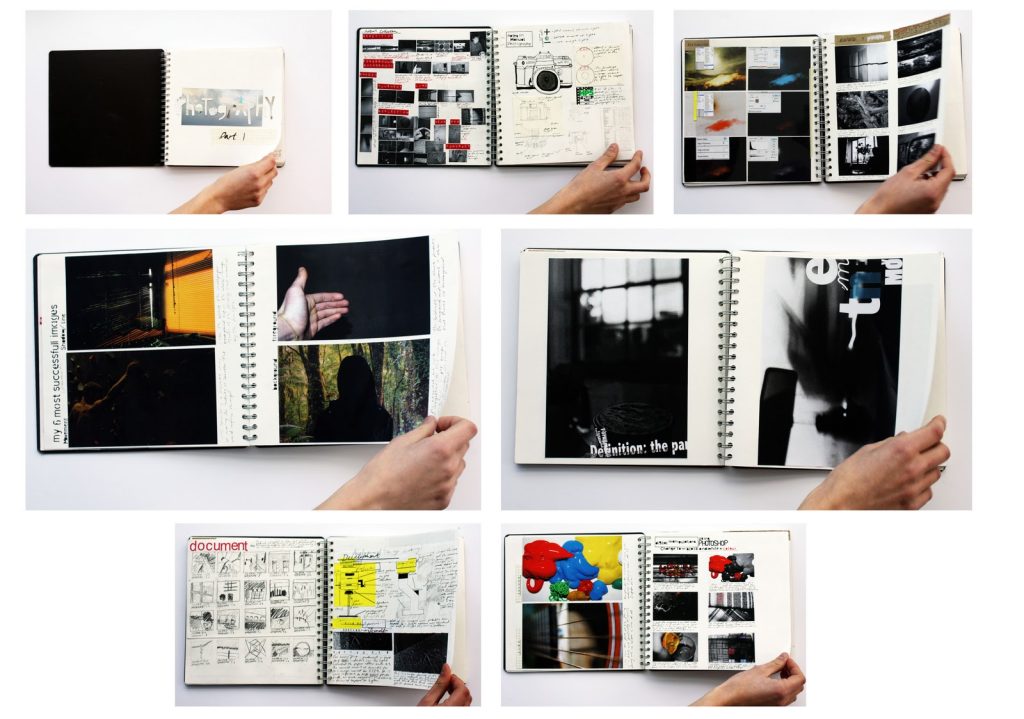
The course focuses on visualizing and properly documenting artistic projects in a clear, comprehensible manner and with a coherent aesthetic. Moreover, it provides students with an initial introduction to a range of both digital and analogue tools and specific knowledge in photography and editorial design. Photographic documentation of processes and results: introduction to the photography techniques and the set. Portfolios, dossiers and other formats of presentation of contents starting in digital format to end up in analogue printed publication. Introduction to digital image processing and editing. Introduction to graphic design tools. Ideation, development, conceptualization and production of works of visualization and documentation.
Through the creation of a self-publication, students will apply a set of processes and skills that will enable them to effectively document their artistic works and processes in both academic and professional contexts.
This course is divided into two working blocks. The aim is to understand the visualization and documentation of artworks as processes that shape and conform the practice itself.
Block 1. Photography. Capturing Time and Space
This block aims to show the consonance between photographic devices, technical processes, and the use of light as constructive elements in the creation of a photographic image. However, the purpose of this thematic block goes beyond the mere use of a specific technique; rather, it is about beginning the creation and management of one’s own photographic work and its application in the field of fine arts through a series of exercises and dynamics.
Block 2. Archival & Editorial design
Students will learn how to create their own image archives and present them coherently in combination with texts. This block introduces the design software InDesign and provides fundamental knowledge of editorial design, including formats, hierarchies, information distribution within a publication, introduction to typefaces, image processing for optimal printing, and an overview of papers and publishing materials.
Evaluation will be ongoing and there will be a single call for the submission of each assignment.
The final grade for this subject will be the result of the sum of the following work blocks and a global qualification.
Block 1: 30%.
Block 2: 35%.
Global: 35%.
Visualisation of audiovisual content
Bibliographic search, documentation research
Practical activities and exercises
Introductory or advanced technical workshops
Preparation of work documentation, portfolios, reports
Oral and/or audiovisual presentations
Collective reviews and follow-ups
Design and execution of artistic projects
Antonini, Marco (2015). Experimental photography: a handbook of techniques. New York, NY: Thames & Hudson.
Belting, H. (2001) The Invisble Masterpiece. Chicago: The University of Chicago Press.
Krauss, R. (2002). Lo fotográfico. Por una teoría de los desplazamientos. Barcelona: G. Gili.
Marnes, Martin (2019). Cameraless photography. New York, NY: Thames & Hudson.
Moholy Naghy, L. (2005). Pintura, fotografía y cine, Barcelona: Gustavo Gili.
InDesign for Beginners | FREE COURSE https://www.youtube.com/watch?v=RXRT3dHu6_o&list=PLgGbWId6zgaX_tirTeXlw85srW5CP552B
The Book Bloc, Ruben Dias (disponible a la biblioteca de Bau)
The Book Cover, Ruben Dias (disponible a la biblioteca de Bau)
Instagram profile of the Thai artist Tum Wuthipol, where reels of original folds for self-publications can be seen: https://www.instagram.com/reel/C-g1oyKSQss/?igsh=MTVteWZudXM1NWZteA==
Grid Systems in Graphic Design. Llibre de Josef Müller-Brockmann
Ways of seeing – John Berger
Episode 1: https://www.youtube.com/watch?v=ZCVXWFIksdM
Episode 2: https://www.youtube.com/watch?v=Va0yxX8a5K4
Episode 3: https://www.youtube.com/watch?v=gHzFyb3pnKo
Episode 4: https://www.youtube.com/watch?v=9X1fR-dUWo4
Cristina Garrido, The (Invisible) Art of Documenting Art.
Anna Maria Guasch, Art and Archive. Genealogy and Contemporaneity (1920-2010)
Comunica a todo tipo de audiencias (especializadas o no) de manera clara y precisa conocimientos, metodología, ideas, problemas y soluciones. (CB4)
Resuelve problemas y situaciones propias del desempeño profesional con actitudes emprendedoras e innovadoras. (CT2)
Elabora informes y documentos escritos (principalmente de carácter técnico) con corrección ortográfica y gramatical en inglés. (CT6)
Utiliza de forma adecuada distintas herramientas y técnicas analógicas y digitales de visualización y documentación del trabajo en procesos proyectivos y productivos. (CE5)
Utiliza el lenguaje específico de las prácticas artísticas además de formatos gráficos, visuales y audiovisuales para comunicar de forma eficaz y expresiva en el ámbito de su trabajo. (CE8)
Aplica de forma adecuada formas ad hoc de estructuración de la información y conexión de contenidos de diversa categoría y procedencia. (CE9)